
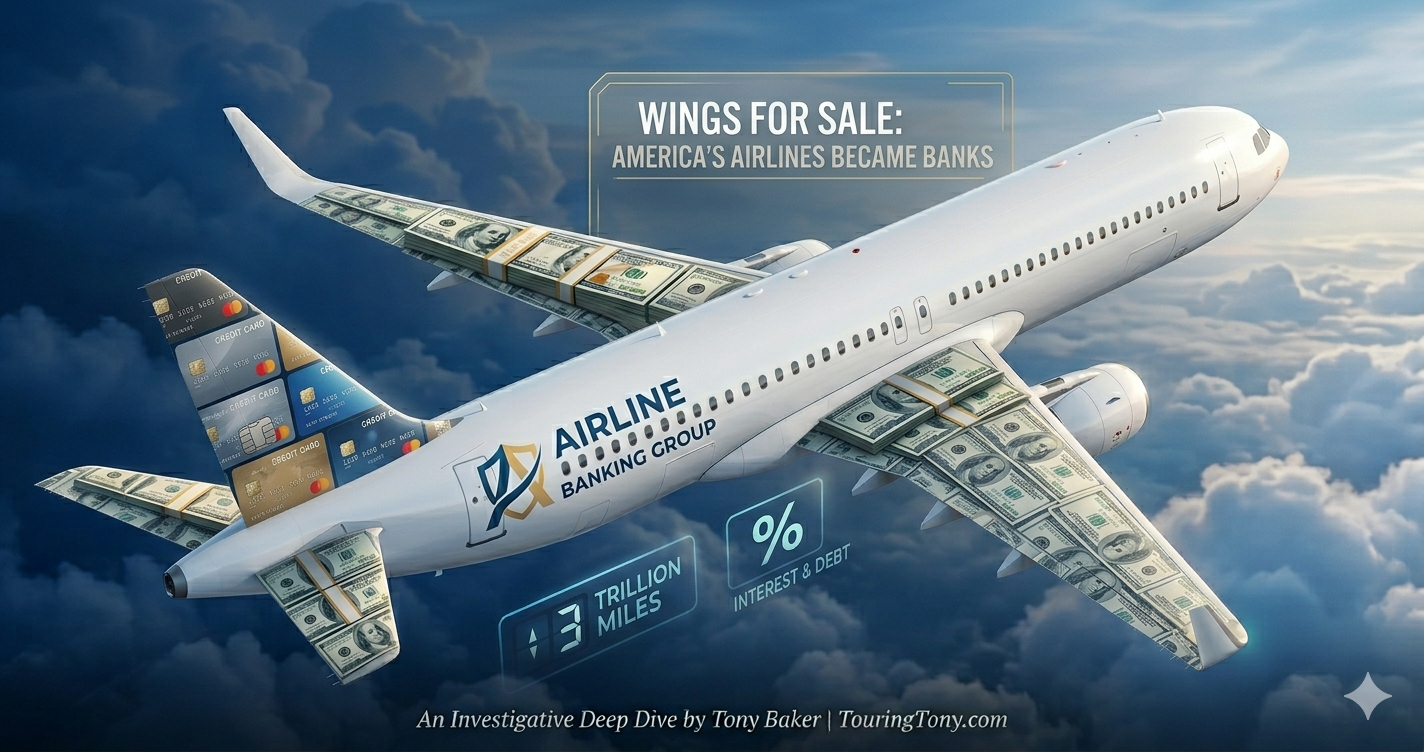
Wings for Sale: How America’s Airlines Became Banks, Built a Sky-High Caste System, and Bet Your Seat on Wall Street
Let me tell you something that is going to make you put down your coffee.
In 2024, every major airline in the United States operated at a financial loss when you strip out loyalty program revenue. Every. Single. One.
Without their loyalty programs and the billions flowing from banks, America’s airlines don’t just struggle. They bleed.
So here is the question nobody in the industry wants to answer out loud: if airlines lose money flying people, what business are they actually in?
“The answer is banking. And you — the person who bought the ticket, showed up at the gate, and sat in a shrinking seat for five hours — you are not the customer anymore. You are the product.”
— Tony Baker, TouringTony.com
This article is not about losing a few miles or a free bag perk. This is about a systemic, industry-wide transformation that is actively discriminating against low-income and minority travelers, creating catastrophic financial risk for shareholders, and building a caste system in the sky that rewards wealth and punishes everyone else. And the laws of three different jurisdictions — the United States, Brazil, and the European Union — are starting to take notice.
Part One: The Machine — How Airlines Became Banks
Let me explain how this actually works, because the mechanics are as brilliant as they are troubling.
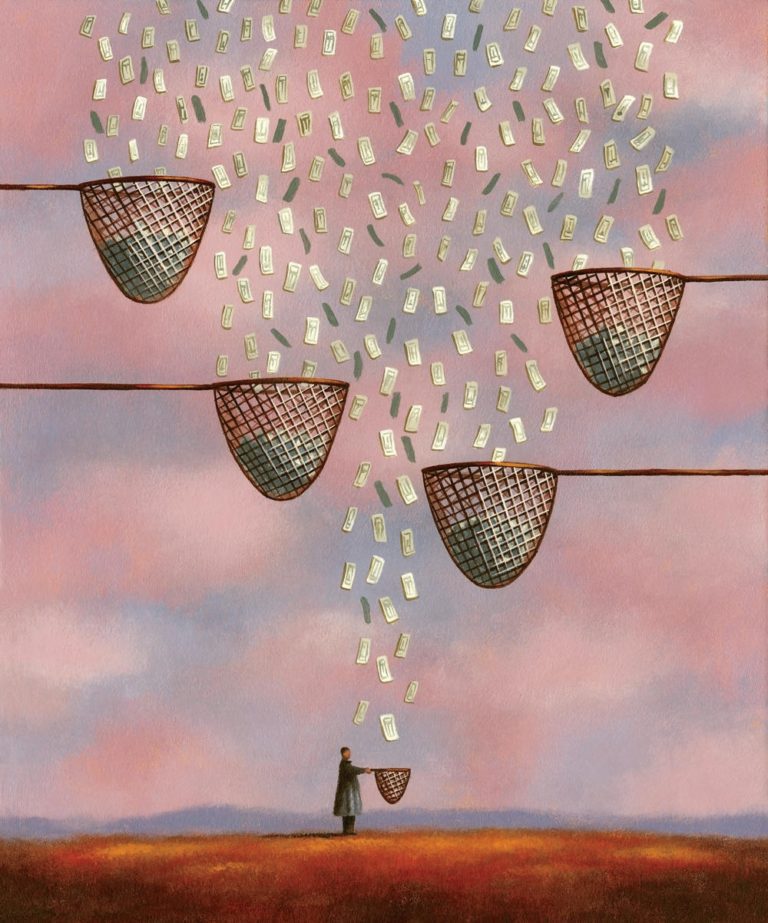
Airlines discovered long ago that selling miles to banks is a FAR better business than selling seats to passengers. The math is staggering.
United securitized MileagePlus for $6.8 billion. Delta borrowed $9 billion against SkyMiles. American Airlines used AAdvantage as collateral for $10 billion — the largest airline-backed financing in history. American’s AAdvantage is valued at ~$24B. United’s MileagePlus at ~$22B. The loyalty program is now worth more than the airline itself.
The profit margin on selling miles to a bank is dramatically higher than the margin on selling a seat to a passenger. United’s leadership has explicitly said in investor calls that their goal is to “capture a higher share of wallet” through financial services. Not fly people better. Not improve the experience. Capture wallet share.
Boy oh boy. We’ve come a long way from Kitty Hawk.
Think about how a government central bank creates money. They print it. The more they print without backing it with real value, the more they inflate the currency and the less your savings are worth. Airlines do EXACTLY the same thing with miles. They create miles from nothing — literally keystrokes on a computer. American Airlines sold 182.7 BILLION miles to banking partners in a single year. Industry estimates put total outstanding miles across all US carriers near 3 TRILLION. That is a currency supply that would make the Federal Reserve blush. And just like a government that prints too much money, airlines systematically devalue that currency — increasing the miles needed for a ticket, restricting availability, hiking award prices overnight with no vote, no notice, and no recourse.
A Delta One business class seat that cost 60,000 SkyMiles years ago now frequently runs 300,000 SkyMiles or more. Same seat. Same flight. Your miles lost 80% of their purchasing power. Industry analysis puts the average annual devaluation rate of airline miles at approximately 15% per year. For context, the worst inflation year in recent US history peaked at around 9%. Your miles are losing value at nearly twice the rate of the worst US inflation in a generation.
“These rewards are controlled by a company that can unilaterally change their value.”
— US Transportation Secretary Pete Buttigieg, 2024
Unlike the dollar — regulated by the Federal Reserve and backed by the full faith and credit of the US government — your miles are backed by nothing except an airline’s pinky promise. You are an unsecured creditor holding an inflating currency issued by an entity with no legal obligation to honor its face value. That is not a loyalty program. That is a rigged game.
Part Two: The Caste System — Who Gets Punished and Why It Matters
Here is where this stops being an abstract financial story and becomes a human one.
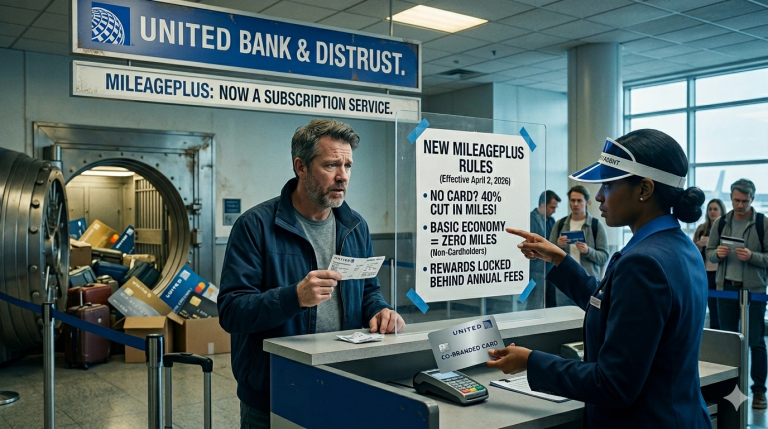
Delta eliminated Basic Economy mile earning years ago. American Airlines followed on December 17, 2025. United Airlines completed the sweep on April 2, 2026. If you buy a Basic Economy ticket on any of the Big Three and you do not hold their co-branded credit card, you now earn zero miles. Nothing. You paid full price for a seat. You showed up. You flew. And the airline told you your business is worth less.
Now let me tell you who buys Basic Economy. It is the cheapest fare. It is the fare purchased by people who are stretching a budget. Students. Immigrant families. Working-class travelers. People flying home for a funeral who just need to get there without breaking the bank.
According to the Joint Economic Committee of the United States Congress: nearly 1 in 5 Americans is unbanked or underbanked. Among Black Americans: 40%. Among Hispanic Americans: 29%. Among families earning under $25,000 per year: more than one-third. These are not people who can simply “go get the credit card.” They are people excluded from the traditional banking system — often because they cannot afford minimum balances, live in banking deserts, or carry the weight of financial histories shaped by systemic inequality. They are also, overwhelmingly, the people buying Basic Economy tickets.
“Airlines didn’t just remove a perk. They looked at the poorest, most financially excluded travelers — the ones already paying full price for a seat — and said: YOU don’t matter to us. Your miles are worthless. Come back when you have a credit card. In my humble opinion, that is not a business strategy. That is discrimination laundered through a points system.”
The bait-and-switch dimension of this story is what really gets under my skin. These airlines spent YEARS recruiting members into their loyalty programs. Join AAdvantage! Join MileagePlus! Join SkyMiles! Earn miles on every flight! Build toward your dream vacation! They filled their member rolls with hundreds of millions of people. They made promises. And then, when those programs became billion-dollar financial instruments — when the loyalty roster was fat and monetizable — they systematically stripped the value from the bottom.
“They did not reduce miles for everyone. They reduced miles for the people who would not or could not sign up for a bank card. That is not a policy adjustment. That is a deliberate wealth transfer disguised as program management.”
— Tony Baker, TouringTony.com
Southwest CEO Bob Jordan said publicly in July 2024 that free bags were worth MORE as a competitive differentiator than the $1.5 billion in annual fee revenue. Customers said it was the #1 reason they chose Southwest. Nine months later — under relentless pressure from Elliott Investment Management, an activist hedge fund — every one of those commitments was gone. Bags now cost $35 and $45. Open seating eliminated. Basic Economy launched. Free bag benefits kept only for loyalty members and credit cardholders. An activist hedge fund did in nine months what 54 years of customer loyalty could not. Wall Street ate Southwest Airlines. And nobody asked you if that was okay.
Part Three: All Eggs, One Bank — The Fiduciary Gamble
Here is the part that should terrify shareholders — and I mean that literally.
Under Delaware corporate law — the governing framework for most US public companies — directors owe shareholders three core duties: the duty of care (act prudently), the duty of loyalty (act in shareholders’ interest), and the duty of obedience (follow the law). The duty of care requires evaluating the full risk profile of strategic decisions, not just the upside. Careless decisions that concentrate risk irresponsibly are not protected by the business judgment rule.
United Airlines has securitized MileagePlus — pledging future loyalty revenue as collateral for billions in debt, with specific revenue covenants it must hit. 100% of that collateral depends on a single banking relationship with JPMorgan Chase. Delta’s entire profit engine runs through American Express. American’s through Citibank. If any of these relationships falters — liquidity crisis, regulatory change, consumer credit collapse — the airline doesn’t just lose revenue. It potentially cannot service the debt it secured against that program.
In 2008, Chase conducted an emergency pre-purchase of $600 million in United miles to provide the airline with emergency liquidity. That cord existed because the relationship was young and the bank was healthy. In 2026, with $1.23 TRILLION in US credit card debt, a financial sector shock that hits the bank AND the airline simultaneously could find no emergency cord available to pull.
A bipartisan bill — backed by Senators Bernie Sanders and Josh Hawley, endorsed by President Trump — proposed capping credit card interest at 10%. Delta received $8.2 billion from AmEx in 2025 and is targeting $10 billion annually. United’s Chief Commercial Officer publicly admitted the airline would be “affected.” Industry advisers at the Dublin aviation finance conference warned the cap would “eviscerate” loyalty programs. JPMorgan CEO Jamie Dimon called it “an economic disaster.” If it passes, the entire profit engine stalls — and the securitized loyalty debt remains on the books.
Airlines securitized loyalty programs and borrowed billions against future revenue. That debt carries covenants — minimum revenue targets they must hit. They then stripped their non-cardholder customers by removing benefits. If the banking sector sours: falling loyalty revenue triggers covenant pressure → airlines force MORE aggressive devaluation to hit targets → more customers flee → weaker program value → worse debt position → more devaluation needed. Round and round, destroying the very asset they borrowed against, in real time, to service the loans that asset secured. Management would be forced to cannibalize the golden goose to feed the banker.
“Management calls this ‘capturing wallet share.’ Shareholders should call it what it is: betting the entire company on a sector — banking — that they have zero control over. You securitized your entire profit engine on a single bank you don’t own. You fired your backup customer base — the cash-paying traveler — in the middle of building a house of cards. If Chase sneezes, you don’t just catch a cold. You potentially default. Is THAT what a fiduciary duty to shareholders looks like?”
Part Four: Does Wall Street Run Your Airline?
The short answer is yes. And the evidence is documented in embarrassing detail.
In 2017, American Airlines gave its pilots a raise of 8% and flight attendants 5%. JPMorgan analyst Jamie Baker immediately downgraded the stock, calling it “a seminal event” and “the first credible blow to our investment thesis.” He warned it had “emboldened unions across the entire space.” The stock dropped more than 7% that day. Wall Street literally punished an airline for paying its workers a living wage. The message to every airline CEO watching was clear: your workers are a cost center. Your credit card deal is the product.
“The co-brand windfall funded a better first class. Not a better economy. Lie-flat beds for the few. Shrinking seats and stripped miles for the many.”
— Tony Baker, TouringTony.com
Better seats cost money. Fewer cancellations require investment in maintenance and staffing. Improved on-time performance means hiring more people. All of those show up as expenses on a quarterly earnings report and trigger analyst downgrades. Selling more miles to Chase? High-margin revenue. Higher stock price. So where does the capital go? Into deepening the financial relationship — not into fixing the product the actual passenger experiences.
“How much profit is enough? American Airlines LOSES money flying. Delta LOSES money flying. But their loyalty programs post record profits. The question isn’t whether they’re profitable — the question is: WHO are they profitable for, and at whose expense? And are the people making those decisions — who will leave with their bonuses intact regardless of outcome — truly acting in the long-term interest of the shareholders they serve?”
Part Five: They Could Do Both — The Evidence From Abroad
Here is something the US airline industry does not want you to know: European airlines have profitable loyalty programs AND they treat their passengers with basic dignity. The two things coexist just fine.
In the United States, credit card interchange fees average approximately 2.4%. In the European Union, they are capped by regulation at 0.3% on consumer credit cards — roughly one-eighth of the US rate. European banks cannot profit enough from interchange to pay airlines as much for miles. So European airlines built profitable businesses the old-fashioned way: by actually flying people well.
American Airlines’ own SEC filings showed that AAdvantage devaluations under previous leadership cost the airline an estimated $200 million in lost card revenue. Why? Because devalued miles give customers less reason to get the credit card. The program worth more than the airline was being destroyed by the executives trying to extract maximum short-term profit from it. The golden goose is not invincible — and they are already squeezing it to death.
“Nobody is saying kill the co-brand card. Keep the Chase deal. Keep the AmEx deal. BUT — use some of that money to fix the actual airline. Wider seats. Fewer cancellations. Better food. Treat the person in row 38 like a human being even if they don’t have your credit card. The idea that you must choose between a profitable loyalty program and a decent airline is a LIE told by people who benefit from the current arrangement.”
Part Six: What the Law Says — USA, Brazil, and the EU
The legal landscape around airline financialization is moving fast, and in multiple directions at once. Here is where things stand.
🇺🇸 United States
The Department of Transportation and the Consumer Financial Protection Bureau launched a formal joint investigation into American, Delta, Southwest, and United. Airlines were ordered to produce documents. The DOT’s authority comes from 49 U.S.C. § 41712, which prohibits “unfair or deceptive practices” in air transportation. CFPB Director Rohit Chopra: “Americans are paying high interest rates to participate in these programs — yet rewards can be depreciated with little notice.” This is bipartisan — Senators Dick Durbin (D) and Roger Marshall (R) formally accused airlines of “unfair, abusive, and deceptive practices.”
The DOT issued a junk fee disclosure rule in April 2024 requiring airlines to disclose all fees upfront before purchase. American, United, Delta, and their trade group sued the federal government to block it. The 5th Circuit Court of Appeals issued a temporary stay on procedural grounds while acknowledging DOT’s underlying authority. These airlines fought in federal court for the right not to tell you what things cost. A November 2024 Senate report revealed US airlines collected $12.4 billion in seat selection fees alone between 2018 and 2023.
🇧🇷 Brazil — The Strongest Legal Frontier
Brazil’s Consumer Defense Code forbids venda casada: conditioning the supply of one product or service on the acquisition of another. The landmark precedent is STJ REsp 1.699.780 (2018) — Brazil’s highest civil court ruled that the airline no-show rule constituted venda casada por via indireta (indirect tied selling). The court’s key reasoning: when a condition serves ONLY the airline’s financial interest and removes genuine consumer choice — even without overtly forbidding an alternative — it is an abusive practice under the CDC. The consumer’s theoretical freedom does not satisfy the law if the practical reality strips that choice of meaning.
Applying the STJ’s framework: a cash-paying Basic Economy passenger earns zero miles in 2026. A cardholder earns bonus miles at rates reaching 11x or more, plus redemption discounts. The airline hasn’t technically forbidden flying without a card. But it has engineered the economics so thoroughly that the “choice” delivers a dramatically debased service. Under the STJ’s framework, is that genuine consumer choice? The answer is legally arguable. CDC Art. 6, Section II adds an equality-of-treatment angle: dramatically different effective rebates based on banking access disproportionately harm Brazil’s unbanked population. Consumer group IDEC and PROCON offices in São Paulo and Rio are actively building formal complaints around these theories.
“No Brazilian court has yet specifically applied venda casada to loyalty program tiering. This is an emerging legal theory grounded in real and consistent STJ precedent — not settled law. But the foundation is solid, the momentum is real, and consumer groups are preparing cases. And remember: Brazil just passed a LAW mandating free checked bags and banning no-show cancellations. The regulatory wind in Brazil is blowing hard against airlines right now. Watch this space.”
🇪🇺 European Union — A Battle in Real Time
EC Regulation 261/2004 entitles European passengers to compensation of €250–€600 for delays over three hours. In 2024, over 287 million European passengers were affected by delays or cancellations. Research showed EC 261 reduced average flight delays by 30% because financial penalties created real incentives to perform. Now the EU Council wants to raise the delay threshold to 4–6 hours — which could eliminate eligibility for up to 60% of currently eligible passengers. The EU Parliament is fighting back: keeping the 3-hour rule, raising compensation, banning hidden fees, and indexing amounts to inflation. This battle is live and unresolved as of April 2026.
“Europe is debating whether to protect passengers MORE or LESS. In the US, airlines are suing the government to avoid disclosing their fees. And Brazil just passed a law saying your bags fly free. We could learn something.”
— Tony Baker, TouringTony.com
Tony’s Verdict
Airlines are no longer transportation companies with financial tools. They are financial instruments with planes attached. That inversion — prioritizing the bank relationship over the passenger — is causing real, measurable harm to real people.
They created programs called “loyalty” programs. They recruited hundreds of millions of members. They made promises. And when those programs became worth more than the airlines themselves, they methodically stripped the value from the bottom up. They kept the benefits for the wealthy and the well-banked. They took them away from the poor, the minority, the unbanked, the student, the immigrant family. They told those people, in the clearest possible financial language: you are not our customer. You are our cost.
They simultaneously bet the company on a single banking relationship they do not control — secured with debt covenants they must hit — at the exact moment a bipartisan political movement threatens to cap the interest rates funding the whole machine. They fired their backup customer base in the middle of building a house of cards on a bank they cannot control.
The co-brand deal does NOT have to mean gutting the airline. European carriers prove it every day. You can earn billions from American Express AND invest some of it in on-time performance, seat comfort, and treating every single passenger — regardless of their credit score — like a human being who chose to spend their money with you.
The choice to do otherwise is a CHOICE. Made by executives accountable to hedge funds and quarterly reports, not to the traveling public. The law in the US, in Brazil, and increasingly in Europe is catching up to what airlines have done. Change is coming.
In the meantime — you are not a customer. You are a data point. The seat they sell you is the loss leader. The card they want you to sign up for is the product. And the miles they promised you are a currency they print freely, devalue quietly, and control completely. Travel anyway. See the world. But go in with your eyes open. And the next time an airline tells you they value your loyalty — ask them to prove it.
Have you felt the sting of a mile devaluation? Did you lose benefits when your airline “updated” their program? Are you one of the travelers being told your cash business isn’t good enough for miles? Drop your story in the comments below — I want to hear it!
Thanks for reading, and PLEASE, TRAVEL MORE!
Disclosure: This article contains affiliate links. TouringTony.com may earn a small commission on purchases at no additional cost to you. This article represents the independent editorial opinion of Tony Baker and was NOT sponsored by any airline, credit card company, or financial institution. Nobody told me what to write here. That’s kind of the whole point.
Stay safe on public airport WiFi — I personally use NordVPN every time I travel. And for international data without the carrier gouging, Airalo eSIM is the smartest thing in my bag.




One Comment