
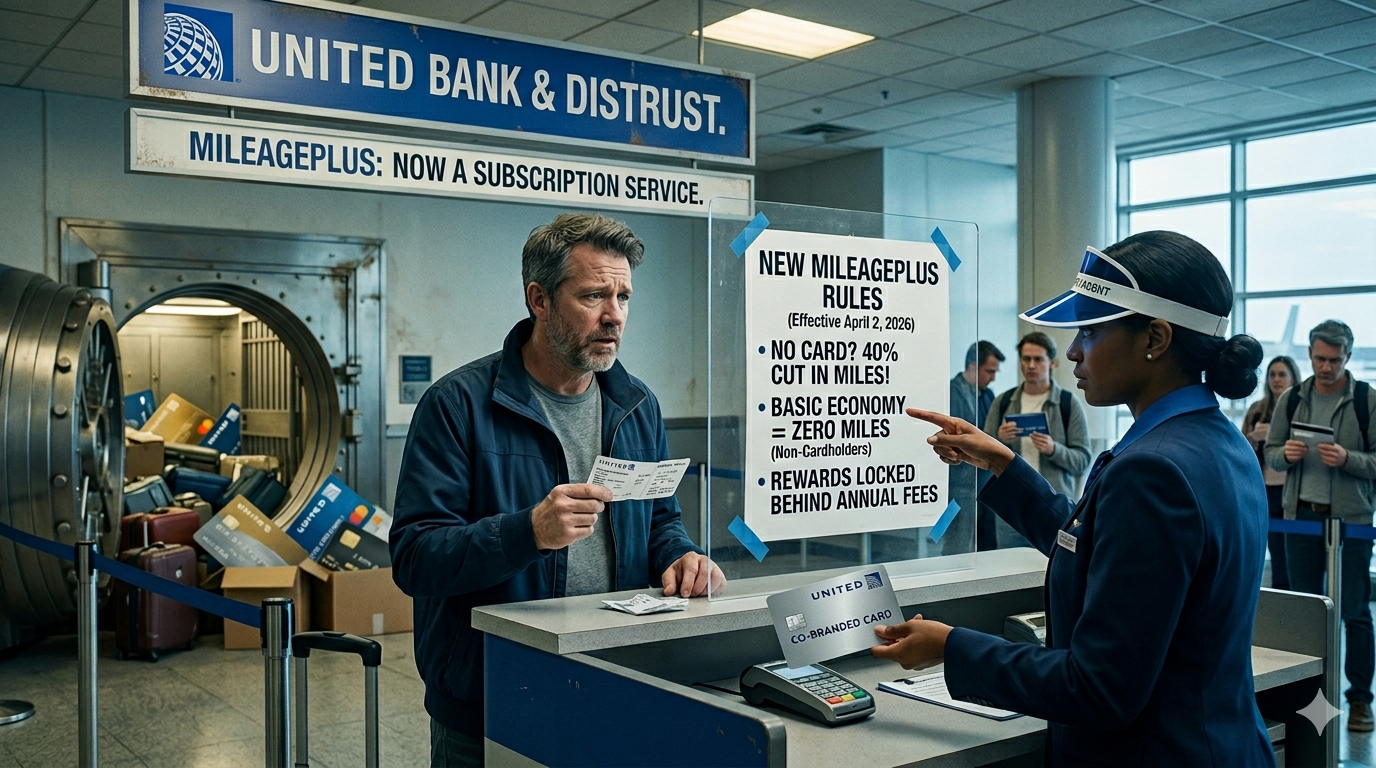
United Bank & DISTRUST!.. A Rant About United Airlines MileagePlus Changes!
I want you to imagine something for a second. You’ve been flying United Airlines for years. You sign up for MileagePlus, you book your flights, you earn your miles, and you feel good about it. You’re a LOYAL customer.
Now imagine that airline quietly walks over, cuts your rewards by 40%, and says, “Oh, by the way — if you want what you HAD before, you need to sign up for our credit card.”
You don’t have to imagine it. That’s EXACTLY what United Airlines just did. On April 2, 2026, the airline officially turned MileagePlus into a pay-to-play program — no longer a LOYALTY or Frequent Flyer program! — and if you’re not carrying their plastic in your wallet, you are now a second-class citizen in their ecosystem.
Let me tell you everything that changed, why it matters, and what I think you should do about it.
What United Actually Changed (The Numbers Are Ugly)
For years, all MileagePlus members earned five miles for every dollar spent on a United ticket. Didn’t matter if you had their credit card or not. Five miles per dollar. That was the deal.
That deal is GONE.
As of April 2, 2026, United split its entire membership base into two camps — cardholders and non-cardholders — and the differences between those two camps are significant. Here’s what the new earning structure looks like:
- General members with NO United card: 3 miles per dollar (down from 5 — a 40% cut)
- General members WITH a United card: 6 miles per dollar (they DOUBLED it for cardholders)
- Premier elite members without a card: Still earn more, but still earn LESS than cardholders at every single tier
- Premier elite members with a card: 8 to 12 miles per dollar depending on status level
And then there’s the Basic Economy gut-punch. If you book a Basic Economy ticket and you do NOT hold a United co-branded credit card and you do NOT have Premier status? You earn ZERO miles. Not fewer miles. Not a reduced rate. ZERO. Nothing. Nada.
On the redemption side, cardholders now get at least a 10% discount when booking award flights, and cardholders WITH Premier status get at least 15% off. No card? Full price. Every time. Simple Flying covered the full breakdown and even they noted that United isn’t just rewarding cardholders more — they are actively PENALIZING everyone else. That’s a very different thing.
This Isn’t a Loyalty Program Anymore — It’s a Subscription Service
Here’s the thing. I’ve been around long enough to remember when loyalty programs actually rewarded loyalty. I was a Diamond Medallion with Delta. I chased SPG Platinum with Starwood before Marriott came in and ruined that beautiful program. I know what a REAL loyalty program feels like.
What United just built is NOT a loyalty program. It’s a subscription service. And the subscription fee is a credit card annual fee.
In my humble opinion, the moment an airline requires you to carry their credit card just to maintain the earning rate you ALREADY HAD, they have crossed a line. You’re not being rewarded for flying more. You’re being penalized for not spending more — specifically, for not spending on THEIR plastic.
United couldn’t have been clearer about their goal here. They want that co-branded credit card in your wallet. Why? Because when you swipe that card at the grocery store, at a restaurant, at the gas station — Chase pays United for those miles. That revenue has NOTHING to do with airplanes. It doesn’t care about weather delays. It doesn’t care about fuel costs. It is a pure, predictable, recession-resistant revenue stream. And the more cardholders United has, the more money flows from Chase to United every single month.
You — the actual flyer — are just the mechanism that makes that financial relationship possible.
Airlines Are Banks. That’s Not an Exaggeration.
I know that sounds dramatic. But look at the numbers.
Delta’s SkyMiles program has been valued at roughly $28 billion — which has at times exceeded the total market capitalization of the airline itself. Think about that. The loyalty PROGRAM is worth more than the actual AIRLINE. American Airlines generates over a billion dollars in operating income from its loyalty program in a single quarter. And according to Simple Flying, Delta and United are two of the most profitable carriers in the world right now — and almost ALL of that profit comes from their frequent flyer programs. Without those programs, they’d essentially break even — or lose money — on the actual flying part of the business.
So let me say it plainly: US airlines are not primarily in the business of flying people places. They are banks that happen to own airplanes. They value your credit card spend. They value your corporate travel account. They value your expense account. And if you’re just a regular traveler trying to earn a free flight by actually FLYING? You are not their priority. You never were.
I wrote about this exact problem when I covered the rumored United and American Airlines merger. Every time airlines consolidate, the same promises get made and the same things get cut. Fares go up, routes disappear, and loyalty programs get gutted. The Big 4 carriers now control nearly 80% of US seats. When you have that little competition, you simply don’t have to care. And moves like this United MileagePlus overhaul prove they DON’T.
They Squeezed You on BOTH Ends
While we’re at it, let’s talk about what cardholders get on redemptions — because it makes the non-cardholder situation even worse.
Cardholders now get priority access to Saver Award seats in Polaris business class. So not only are non-cardholders earning fewer miles — they’re ALSO paying more miles to redeem them, AND competing for worse award inventory when they try. You earn less. You spend more to redeem. You get access to fewer seats. They squeezed you at EVERY step.
And before anyone says “well just get the card” — I hear you. But that’s EXACTLY what United wants you to say. That’s the whole point of making the non-cardholder experience painful enough that you give in. Boy oh boy, it is a well-designed trap.
Should United Be Regulated as a Bank, Not an Airline?
Is it legal? I’m not a lawyer — but I’ll tell you this: in the United States, we have RIGHTS as consumers. And when an airline that calls itself a CARRIER starts operating like a BANK, someone needs to be asking hard questions. Should United Airlines be regulated by the FDIC or another financial regulator? Should Congress be looking at this? SOMEBODY should, because it’s pretty clear these companies are in the credit card business — and the flying part is just the marketing.
United is a public company, and yes, they have a legal obligation to protect their shareholders. I get that. But completely transforming an essential transportation service into a financial instrument is not necessarily what that means. At what point does the Department of Transportation step in? At what point do consumer protection laws kick in? These are questions SOMEBODY in Washington should be answering — because the airlines sure aren’t going to answer them voluntarily.
Is any of this surprising given where the entire US airline industry is headed? Not really. But is it the death of what a frequent FLYER program was ever supposed to be? YES. One hundred percent yes.
What Should You Actually Do About This?
Look, I’m not going to tell you what to do with your wallet. But here’s my honest take:
- Stop being blindly loyal to any single airline. I walked away from Delta loyalty years ago and I don’t regret it for a second. Shop the fare. Fly whoever makes sense for your route and your budget on that specific trip.
- If you fly United constantly, run the card math. The difference between 3 miles and 6 miles per dollar is real money over hundreds of flights. If the numbers work for YOUR situation, fine. But don’t get the card just because they scared you into it.
- Diversify into flexible points currencies. Chase Ultimate Rewards, Amex Membership Rewards — these transfer to multiple airlines. If United devalues MileagePlus overnight (and they HAVE done it before), your points aren’t held hostage.
- Watch Basic Economy like a hawk. Before you book that cheap ticket, check the fare class. “Basic” now means “no miles, no help, no flexibility” for most people. Sometimes paying $20 or $30 more for regular economy is absolutely worth it.
- Protect yourself on the road. Especially on airport and hotel Wi-Fi. I use NordVPN every time I travel — grab NordVPN here and don’t give airlines OR hackers another way to take your money.
The Bottom Line
United Airlines made a calculated, deliberate business decision on April 2, 2026. They decided that their most valuable customers are the ones who carry their credit card — not the ones who fill their seats the most often. They cut earning rates for non-cardholders by 40%, stripped miles from Basic Economy purchases entirely, locked better award pricing behind the cardholder wall, and handed Saver Award inventory to cardholders first.
The frequent flyer program used to mean something: fly with us, and we’ll reward you for it. Full stop. What United has built now is completely different — pay us via credit card, spend on our card every month, THEN we’ll reward you. And even then, only on our terms.
If the airlines won’t be loyal to YOU, you don’t owe them your loyalty either. Shop smart. Diversify your points. Read the fine print before every single booking. And never let an airline make you feel like you NEED them.
What do you think about United’s MileagePlus changes? Are you going to grab the card, or are you done with United altogether? Drop a comment below — I read every single one and I want to hear from you!
Thanks for reading, and PLEASE, TRAVEL MORE!



One Comment