
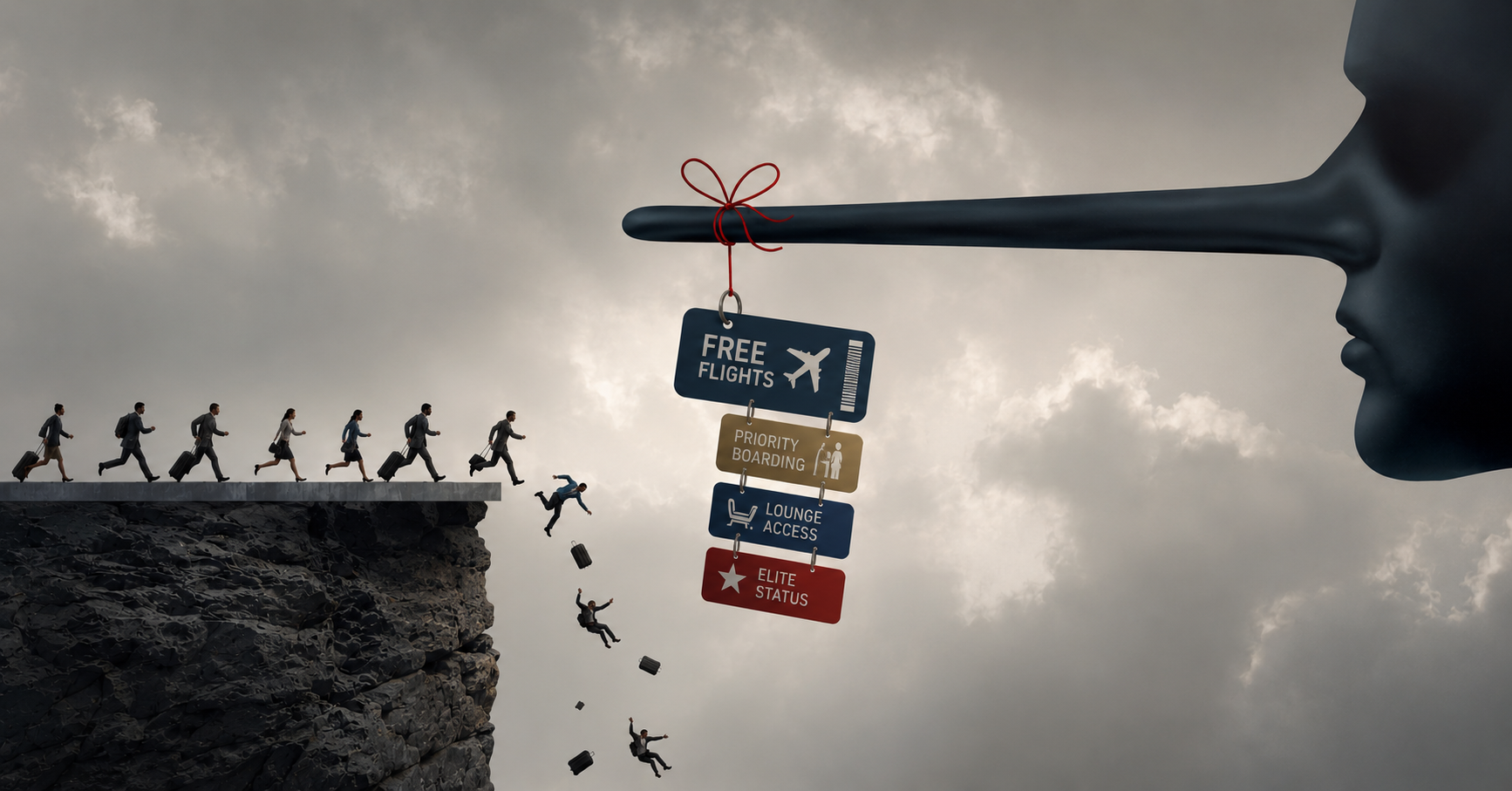
Airlines Made You A Promise. Here’s Exactly How They Broke It.
A Delta frequent flyer recently went public with a story that stopped me cold. She had accumulated 2 MILLION SkyMiles over 25 years of loyalty — two million — and this summer, she cannot get to France. Not without paying through the nose in cash, which is supposed to be exactly what all those miles were for. Here’s the thing: this isn’t a glitch. It isn’t bad luck. It is the system working precisely as designed. And it isn’t just Delta.
⚡ Quick Summary
- Bottom line: Every major US airline loyalty program has delivered measurably less value than it promised — while generating record revenues from the same customers.
- SkyMiles today: Worth approximately 1.1–1.2 cents per mile — down an estimated 23% from their 2017 peak value.
- Not just Delta: American stripped AAdvantage miles from Basic Economy fares in December 2025; United’s MileagePlus has followed its own devaluation trajectory.
- The real money: The top 5 US airlines generated $28 billion in loyalty revenue in 2024 — mostly from credit cards, not from you actually flying.
- Tony’s take: Miles still have strategic value, but the original promise — loyalty rewarded with free travel — has been quietly retired. Walk in with your eyes open.
What Did Airlines Actually Promise When They Launched These Programs?
Short answer: A simple, compelling deal — fly with us, earn miles, use miles to fly free. For roughly the first two decades of loyalty programs, that deal was kept. Fixed award charts meant a round-trip to Europe cost a predictable, published number of miles. You could plan for it. Save toward it. Count on it.
American AAdvantage launched in 1981. United MileagePlus followed shortly after. Delta’s Frequent Flyer program — which became SkyMiles — was built on the same premise. You earned miles by flying, you redeemed miles for flights, the prices were published, and the whole thing made intuitive sense.
I’ve been collecting and redeeming miles for years. Let me tell you — in the early days, a business class redemption to Tokyo felt like a genuine reward because it WAS one. The math worked. A mile was worth something predictable. You earned X, you got Y. The promise held.
Something started shifting around 2010. By 2015, it was obvious. Airlines had discovered that loyalty programs are worth far more as financial products than as travel reward systems. The customers were still swiping their co-branded cards, still accumulating miles, still motivated by the dream of free travel — but the dream was quietly being repriced.
How Did Delta Change the Rules — and Why Did We Let Them?
Short answer: Delta eliminated its fixed award chart in 2015, moving to fully dynamic pricing. That single decision ended predictability for SkyMiles holders. Every other major carrier watched and took notes. Delta was aggressive and early — but they weren’t alone for long.
Let me be direct about this, because I write about Delta a lot and I want to be fair: Delta has been the most aggressive of the Big Three in systematically making its loyalty program less valuable while keeping the marketing language of “rewarding loyalty” intact.
The Delta Timeline: How It Happened
- 2015: Delta eliminates its fixed award chart entirely — award prices become dynamic, set per flight, per date, per seat
- 2023: Medallion status overhaul — earning elite status becomes primarily spend-based, not miles-based; frequent flyers without co-branded cards lose ground
- 2026: Flying Blue (Air France/KLM), a key Delta partner, slashes award rates on Delta-operated flights
The result? A traveler accumulates 2 million miles over 25 years and can’t get to Paris in summer 2026. That is NOT a coincidence or bad timing. Dynamic pricing means Delta sets the award price at whatever the algorithm says maximizes yield. When demand is high — summer Europe, for instance — the algorithm prices awards out of reach. The miles are “available.” The seats are “available.” The price in miles is just prohibitive. EVERY. SINGLE. TIME. demand is high.
Follow the Money
Strip out the loyalty revenue — the credit card partnerships, the miles sold to banks — and Delta would have been operating at a loss in 2024. The airline is, in large part, a loyalty program that also flies planes. I wrote about the financial architecture of this in depth before — go read my Wings for Sale piece if you want the full breakdown — but the bottom line is that the incentive structure is completely inverted. The more you swipe your Delta card, the more Delta benefits. The value of the miles you accumulate? That’s a separate, and increasingly worse, deal.
Is Delta the Only Airline Shortchanging Its Members?
Short answer: Delta moved first and most aggressively, but American and United have followed their own devaluation playbooks. American stripped AAdvantage miles from Basic Economy fares in December 2025 — the fastest-growing fare class in domestic aviation. No major US carrier has kept its loyalty promises fully intact. Not one.
Let’s talk about American. In December 2025, American Airlines stripped AAdvantage miles from Basic Economy fares — the fastest-growing ticket class on domestic routes. If you bought a Basic Economy ticket, you earned nothing. AAdvantage is valued at $26.7 billion. The estimated value per mile has dropped roughly 18% from its 2018 peak.
United MileagePlus — program value $25.3 billion — has had its own trajectory. I’ve gone into specifics on United’s moves in other posts, so I won’t rehash everything here. The pattern is consistent: award availability tightens, mile prices increase, partner redemptions get clipped.
What Your Miles Are Actually Worth Now
| Carrier | Program Value | Est. Value/Mile (Peak) | Est. Value/Mile (2026) | Est. Change |
| Delta | $31.7B | ~1.5¢ (2017) | ~1.1–1.2¢ | -23% |
| American | $26.7B | ~1.7¢ (2018) | ~1.4¢ | -18% |
| United | $25.3B | ~1.5¢ (2018) | ~1.3¢ | -13% |
Estimates based on published industry trackers (NerdWallet, DollarFlightClub, ThePointsGuy). Actual redemption value varies by route and redemption type.
The Double Hit: Miles AND Benefits
And it wasn’t JUST the miles losing value. At the exact same time the purchasing power of your miles was shrinking, the airlines were quietly cutting the benefits that made the programs worth joining in the first place. Delta restricted Sky Club lounge access in 2023 — once a genuine perk of holding the right credit card — now requiring Platinum status or a premium card tier just to get through the door. Status earning shifted to favor spending over actual flying time. Award upgrade availability tightened across all three carriers. Partner redemption rates got slashed. They didn’t just make your miles worth less. They made the entire membership worth less, at the same time, on purpose.
The Private Equity Playbook
Here’s the analogy that I keep coming back to: this is the private equity playbook. The same one that gutted Red Lobster and Toys R Us. Buy a beloved brand, extract maximum value, load it with debt, and sell the future. Red Lobster sold its own restaurants and then paid rent on them until it couldn’t anymore. Toys R Us paid private equity management fees while Amazon ate its lunch. The airlines did something remarkably similar — Delta literally used SkyMiles as collateral for a $6.5 billion loan during COVID. United pledged MileagePlus for billions more. They securitized the very program their most loyal customers trusted, while simultaneously cutting its benefits and devaluing its currency. The golden goose is still alive and still laying. But it’s been plucked nearly clean, it owes billions, and the passengers still dutifully swiping their co-branded cards are the last ones to find out what’s actually happening in the coop.
And here’s the number that puts ALL of it in perspective: strip loyalty revenue out of the top 5 US carriers’ financials in 2024, and the industry generated approximately $28 billion in loyalty revenue — the overwhelming majority from co-branded credit cards, not from actual ticket purchases. Over 70% of loyalty income comes from non-airline partners. These programs are credit card businesses with airline benefits attached. When you understand that, the devaluation pattern makes complete sense. Your miles are the product being sold to banks. You are the customer of the bank, not the airline. And THAT, my friends, is the part airlines will NEVER put in the marketing brochure.
Why Did the U.S. Government Launch an Investigation?
Short answer: In 2024, the U.S. Department of Transportation opened a formal probe into airline loyalty programs, specifically targeting transparency around point valuations, devaluation practices, and redemption restrictions. When the federal government starts asking formal questions about your loyalty program, the problem has moved well past “inconvenience.”
The DOT’s investigation centers on whether consumers have enough accurate information to understand what their miles are worth — and what the rules are for using them. That’s a polite way of saying: are these programs transparent enough, or are customers being misled?
Boy oh boy — the fact that a federal investigation was even necessary tells you everything. Travelers have been raising these concerns for years. The loyalty programs kept saying “our miles are valuable, here’s how to maximize them” while simultaneously raising award prices and tightening availability. When the government notices the gap between those two things, you know it’s gotten egregious.
The investigation is ongoing. I’ll be watching it closely. But even if nothing comes of it regulation-wise, the message is clear: the DOT looked at airline loyalty programs and saw enough of a problem to open a file.
Should You Still Bother Collecting Miles in 2026?
Short answer: Yes — but with a completely different mindset than the original pitch. Miles as a long-term savings vehicle toward aspirational travel? That model is largely broken. Miles as a tactical tool for specific, time-sensitive high-value redemptions? Still works, if you’re disciplined.
Here’s where I’ve landed after thinking about this for years, and flying a LOT of miles to form that opinion. I still earn miles. I still redeem miles. But I treat them like a depreciating asset, not a savings account. I earn and burn — accumulate miles on routes I’m flying anyway, redeem relatively quickly, focus on partner international business class redemptions where the cash equivalent is highest.
Domestic short-haul redemptions? Almost NEVER worth it anymore. Five thousand miles for a $150 ticket is a terrible return on miles that could have gone toward a $3,000 business class seat instead. In my humble opinion, the domestic award redemption died quietly around 2019 and nobody issued a press release.
And here’s my honest take: the airlines are not going to stop this trajectory. The loyalty programs are too valuable as financial products. As long as people keep swiping co-branded cards — and they will, because the sign-up bonuses are genuinely good — the airlines have no structural incentive to improve redemption value. The woman with 2 million SkyMiles sitting at home this summer is an extreme example. But it’s also where the math has always been heading.
Use the TouringTony Travel Hub to compare loyalty programs and credit card sign-up offers before you decide where to park your spending. And check my summer 2026 airfare warning before you book anything this year — the cash prices are ugly too.
Frequently Asked Questions
Are airline miles still worth collecting in 2026?
Yes, but strategically. Miles work best as a tool for specific high-value redemptions — particularly international premium cabin awards where cash prices are $2,000+. For domestic short-haul flights or low-cash-value redemptions, the math rarely makes sense in 2026. Earn and burn quickly; don’t treat miles as a long-term savings account.
Which US airline loyalty program offers the best value per mile right now?
By most published estimates, AAdvantage (American) edges out the others at approximately 1.4 cents per mile, followed by MileagePlus (United) at ~1.3 cents and SkyMiles (Delta) at ~1.1–1.2 cents. But program “value” is only part of the picture — partner availability, award chart structure, and which airlines serve your home airport matter just as much.
Why did airlines eliminate fixed award charts?
Dynamic pricing gives airlines complete control over award prices in real time — they can price awards higher when cash demand is high, effectively keeping the best seats for cash buyers. A fixed award chart creates a published obligation to the customer. Dynamic pricing creates no such floor. Delta pioneered this model in 2015, and the other carriers followed.
What is the DOT investigating about airline loyalty programs?
The U.S. Department of Transportation launched a formal investigation in 2024 into loyalty program transparency — specifically targeting how airlines communicate (or don’t) about point valuations, devaluation, and redemption restrictions. The probe is ongoing. It was triggered by years of consumer complaints about the gap between what programs promise and what they actually deliver.
Is this devaluation trend likely to continue?
Almost certainly. Loyalty programs are the most profitable segment of the airline business — more profitable, in several cases, than flying. There is no financial incentive for airlines to improve redemption rates as long as co-branded credit card spending keeps growing. The trend since 2015 has been consistent across all three major carriers.
Related Articles:
- Wings for Sale: How Airlines Became Banks (And What That Means for Your Miles)
- Summer 2026 Airfare Warning: Why Flights Are So Expensive Right Now
- Basic Economy Fares: Everything They Don’t Tell You Up Front
- TouringTony Travel Hub: Points, Cards, and How to Travel Smarter
Thanks for reading, and PLEASE, TRAVEL MORE!
Have you been burned by a loyalty program devaluation? Got a story like the 2 million SkyMiles woman? Drop it in the comments — I read every single one, and I’d love to hear what you’ve experienced firsthand.





6 Comments